
The romantic engineer
The politics of visual thinking

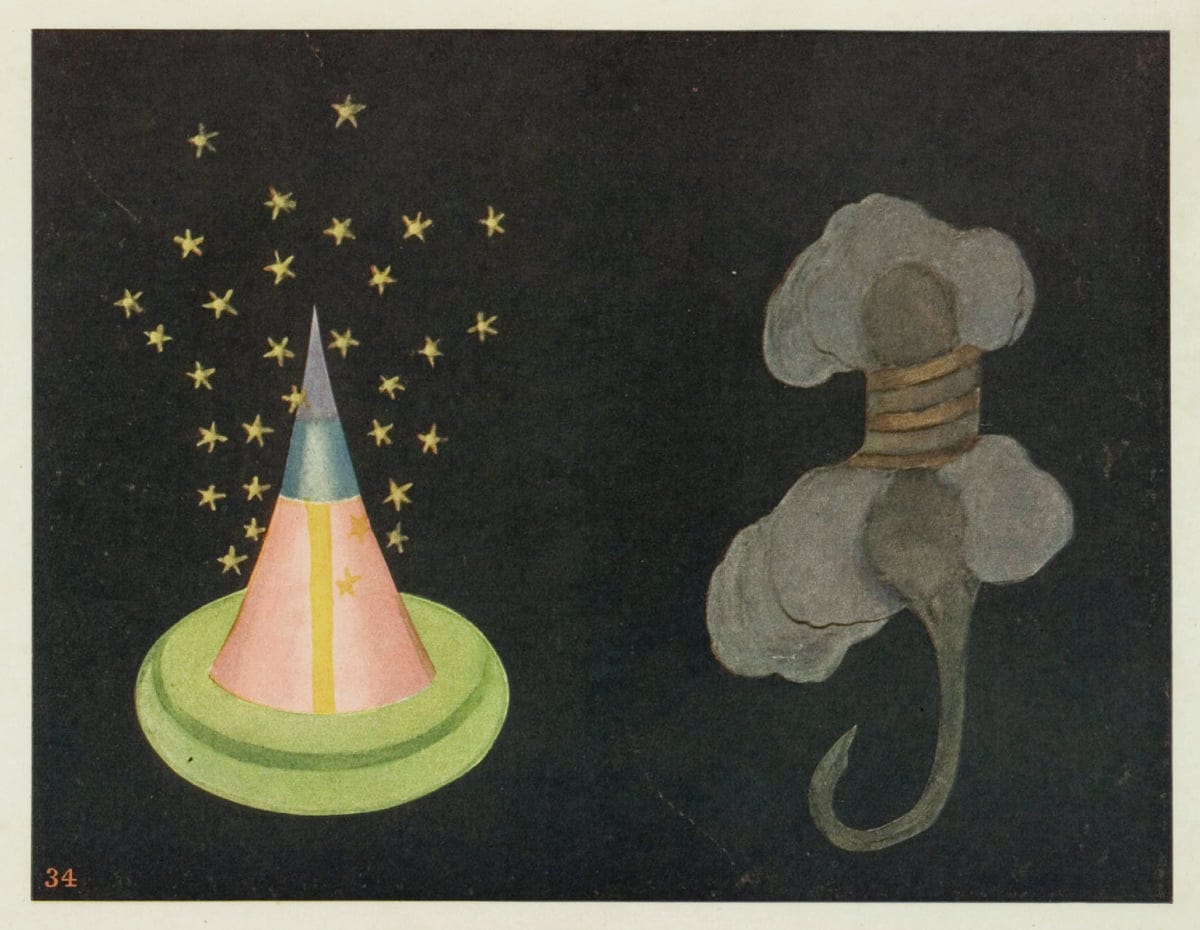
If “romantic engineer” is an archetype, this figure looms large in Switzerland’s psychic landscape. I’ve been thinking about it since my trip to Geneva, whose old city district is filled with shrines to mechanically sophisticated play: stores that sell nothing but music boxes, or model airplanes, or automated figurines. Swiss toycraft casts the banality of the algocene in high relief by way of contrast. It’s not sleek or impersonal; it’s more forest witch than sci-fi. For forty-eight hours, it made me feel like a kid again.
While I’m not immune to its charms, I see it as linked to political elitism. This week, I’ve been re-reading Jeffrey Herf’s 1984 book Reactionary Modernism: Technology, Culture, and Politics in Weimar and the Third Reich, the main inspiration for my recent essay on the politics of psychedelic science. Reactionary Modernism describes how intellectuals and engineers in pre-WWII Germany viewed innovation differently than their French and Anglophone peers. As Herf writes, Germany once lacked a strong liberal ethos; until the Weimar era, Germans generally looked askance at industry and innovation. In the interwar period, a coalition formed to promote a more affective and spiritual understanding of technology, a vision better fit for the national culture. Where the German technological imaginary was once filled with specters of the bloodless and dispossessed (i.e., the Jewish), it now contained glorified depictions of masculinity, heredity, and creativity freed from the bondage of capital.
In this picture, technology held the potential to revive a German spirit in decline after WWI. Weimar thinkers like Ernst Jünger, Oswald Spengler, and Werner Sombart made common cause in connecting the work of engineers to a transhistorical and enchanted Germanness. This essence is palpable in objects whose formal perfection effects a certain eldritch magic. Watches that never lose time, perfectly-scaled models, and uncanny automata disclose a secret sympathy between innovation and aristocracy. They’re avant-garde, anti-massification, resilient against the steady creep of generic devices that tend towards malfunction and obsolescence. They make globalized production seem perverse.
This might seem strange to those familiar with German critical theory. The golden age of reactionary modernism overlaps with the establishment of The Frankfurt School, a group of scholars affiliated with the University of Frankfurt am Main. Frankfurt School critical theorists like Max Horkheimer, Theodor Adorno, and Walter Benjamin described technology as a source of widespread anomie and spiritual enervation whose rise was inextricable from that of global capitalism. While the reactionary modernists reimagined technology to accord with illiberal politics, the Frankfurt School suggested that no amount of creative thought could rescue it from its predetermined trajectory, which carries out the project of the Enlightenment to terrible extremes — a world shorn of wonder, all science and calculation.
The two schools of thought made their points in different ways. Reactionary modernists relied on analogies between biological and man-made systems to portray the engineer as a kind of natural alchemist. The Frankfurt School adopted a Marxist lens, describing the technological as all too human, a force discontinuous with and hostile towards the sacred. Both groups rejected liberal political economy, but the former saw a place for technology in National Socialism while the latter understood it as nothing more than an alibi for capitalism.
Today, analogies between the natural and the biological form the discursive basis for research agendas such as AI, systems theory, and cognitive science. In some cases, these comparisons bear out practically — if they had no empirical merit whatsoever, we wouldn’t have biomimetics. But we have to be careful with rationales for innovation drawn from rhetoric that reduces the workings of biological life, including human life, to that which we can “see” — either literally or with our mind’s eye, with or without technological assistance — and articulate through a shared vernacular of images rather than abstract concepts, that is, notions only tractable in written and spoken language. I say this because image-laden discourses are setting the terms for how we conceive science and technology in the 2020s. While it’s always been politically expedient to embrace abstract thought, this is especially important as Silicon Valley continues to align itself with Trump. History shows that when our thinking about science and tech has been captured by the imagistic, it tends towards the anti-human. To reject the conceptual on principle is to participate in a well-established fascist tradition.
As Herf explains, interwar anti-intellectualism thrived under literary and philosophical pretenses thanks to Jünger et al. This warrants comparison to how Peter Thiel and Marc Andreessen present themselves on the world stage today. Whether the reactionary modernists were “real” intellectuals or not matters less than the goals they pursued; we might say the same of Bay Area thought leaders. And it’s no coincidence that the reactionary modernists made appeals to a population of under-employed engineers that had little prior interest in the philosophical. See this passage, which explains how Carl Weihe, editor of the journal Technic und Kultur, upheld Arthur Schopenhauer as an emblem of “healthy” or anti-conceptual German philosophy:
All over Europe, those drawn to fascism were heirs to and exponents of a tradition of anti-intellectualism. The German engineers were no exception. The intimate relationship between modern technology and natural science – especially evident in Germany’s electrical and chemical industries – did not stop Weihe and others from expressing open hostility to conceptual thought. It was wrong, he wrote, to claim that technology had been the product of abstract reason. On the contrary, it was the “infusion of spirit into labor power” (Vergeistung der Arbeitskraft), and a symbol of the Social Darwinist struggle for existence. Weihe added a Schopenhauerian twist to reactionary modernist rhetoric when he distinguished between a “visualizing” and “conceptual” thought. Schopenhauer’s thought was “closer than any other philosopher” to that of engineers. His “world-affirming will and high evaluation of visualizing thinking” (anschauliches Denken) stood in starkest contrast to conceptualization. (175)
Throughout his career, Weihe popularized the idea that communication and essence, the fungible and the integral, could not be reconciled, placing visuality and technology on the “pure” side of the binary. This way of thinking justifies pseudoscientific explanations for racism, sexism, and other deeply visual forms of discrimination.
To give up on conceptual thought is to give up on society, at least if we understand society as a site where different kinds of people can flourish alongside one another. If we accept that culture is now ruled by visual spectacles (or ineffable “vibes”), we accept a politics that sees likeness and similitude as intrinsically valuable at the same time that it antagonizes the different and strange — anything that confounds easy recognition.
Maybe the hard work of thinking seems unnecessary in the age of machines that appear to do it very well. Such an attitude, however, only supports those who court philosophy to the degree that it presents visual thinking, or pattern recognition, as superior to abstract conceptualization (see: Thiel’s interest in René Girard). These guys use big ideas to get one over on a public they see as profoundly gullible. In my more pessimistic moments, I’m afraid they might be as successful as their predecessors.
I’m completely lost with the paragraph about the imagistic and abstract thought. At one moment you seem to be equating the two, at the next opposing them, then back again. Could you please lay out your definitions of the two a bit more?